

A maintenance engineer is alone in a plant room. A housing officer is doing a void inspection on an empty property. A night-shift operative is walking a distribution centre that will not see another person until 06:00.
One of them presses the SOS button. Or does not press anything at all, because they are unconscious on a concrete floor and the device has detected the fall by itself.
The alarm now exists. It is travelling. And everything that happens next depends on one thing: whether a trained human being is awake, on shift, and contractually obliged to act on it.
That is the job of an alarm receiving centre. This guide explains what one actually does, which UK standards separate a real ARC from a phone on someone's bedside table, and how to decide whether to outsource your lone worker monitoring at all.
An alarm receiving centre (ARC) is a permanently staffed facility that receives alarm signals from remote devices, verifies what is happening, and escalates to the right people — including the emergency services — according to a documented procedure.
It is not a piece of software. It is a physical room, with resilient power, redundant communications, restricted access, and operators on rota twenty-four hours a day, every day of the year. The building itself is part of the certification.
UK procurement documents use these terms interchangeably, which causes real confusion in tenders. For practical purposes:
When you write a specification, use alarm receiving centre and name the standard you require. That removes the ambiguity in one line.
The value of an ARC is not that it receives a signal — your own phone can do that. It is what a trained operator does in the ninety seconds that follow.
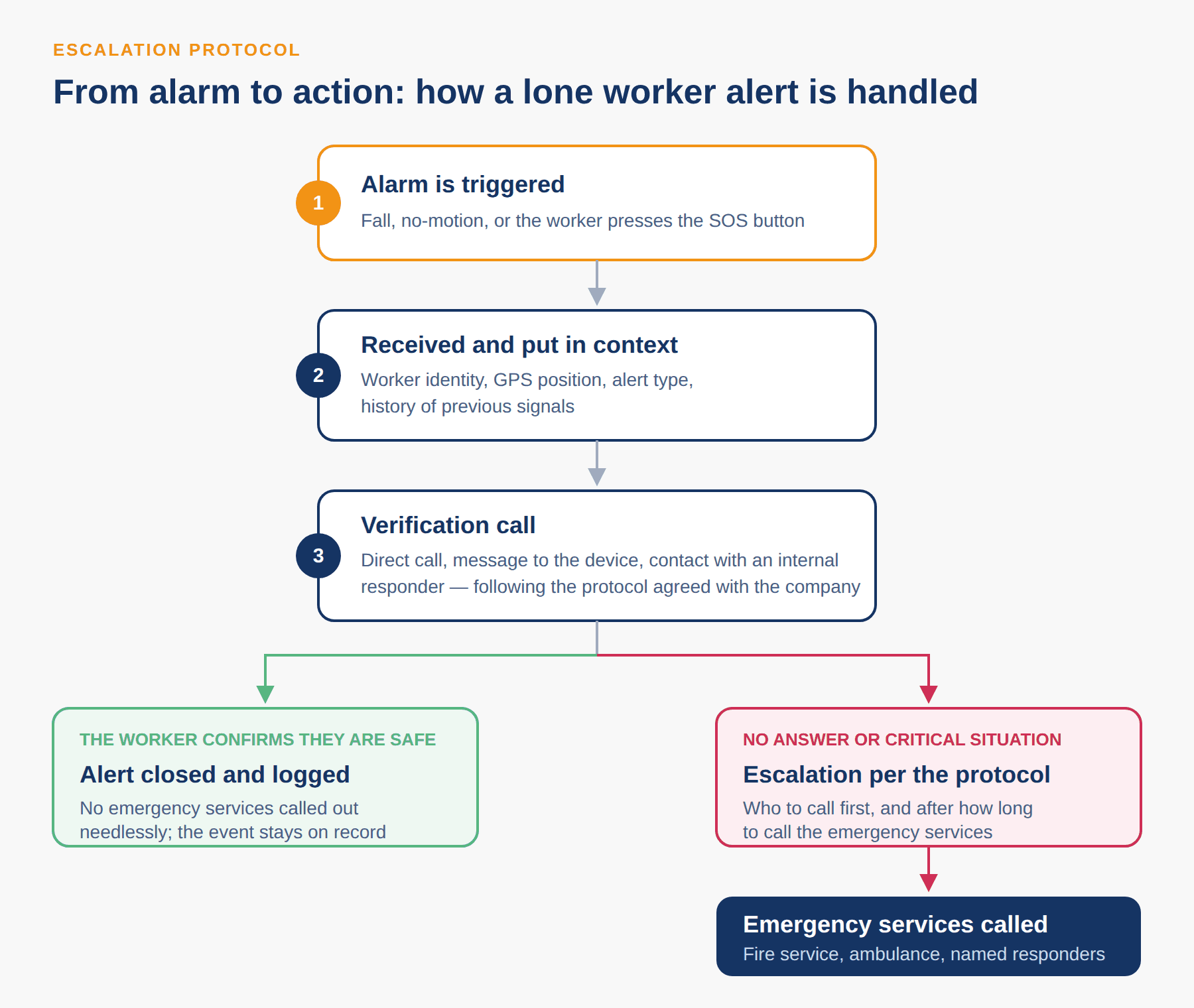
This is where most lone worker projects go wrong. Buyers ask for a "monitored" solution without specifying what the monitoring is certified against, and end up comparing a certified ARC with an out-of-hours answering service on price.
BS 8484:2022, Provision of lone worker services — Code of practice, is the reference standard in the United Kingdom. Its scope is broader than the device: it covers the device itself, the service provider behind it, and the alarm receiving centre that handles the calls.
Two consequences follow, and both are commercial rather than technical:
Where BS 8484 governs the lone worker service, BS EN 50518 governs the monitoring and alarm receiving centre itself: construction and physical protection of the building, redundancy of equipment, communications resilience, staffing, and operating procedures.
It replaced the older BS 5979 regime. If a supplier still quotes BS 5979 at you, that is worth a question — not necessarily a red flag, but worth a question.
British Standards do not audit anyone. Certification bodies do. In the UK security sector the two that matter are the National Security Inspectorate (NSI) and the Security Systems and Alarms Inspection Board (SSAIB), both UKAS-accredited.
NSI's highest tier for an alarm receiving centre is NSI Gold. When a supplier tells you their centre is "certified", the useful follow-up is short: certified by whom, to which standard, and can I see the certificate number and its expiry date?
A Unique Reference Number (URN) is issued by a police force to an alarm receiving centre, and it is what allows that centre to pass an alarm to the police as a monitored alarm rather than as a 999 call from a stranger.
URNs come with obligations, and they can be suspended — typically where a site generates repeated false alarms. That is not an administrative detail. It is the reason false alarm rates matter commercially, not just operationally: a centre that cannot filter noise loses the very route that made it worth paying for.
| What you might ask for | What it actually governs | Ask for the evidence |
|---|---|---|
| BS 8484 | The whole lone worker service: device, provider, ARC | Certificate, scope, certification body |
| BS EN 50518 | The alarm receiving centre building, systems and staffing | Certificate number and expiry |
| NSI Gold / SSAIB | Who audited the centre, and to what tier | Named certification body |
| URN held | Whether police response is actually available | Which force, and current status |
| "24/7 monitoring" | Nothing, on its own | Minimum operators on shift at 03:00 |
Handling your own lone worker alarms is not unreasonable. Plenty of organisations do it well — during the working day. The model breaks in predictable places, and it is worth being honest about which ones apply to you before signing anything.
| Constraint | In-house rota | Certified ARC |
|---|---|---|
| Cover at 03:00 | Demanding rotas, and a real risk of nobody picking up on a given night | Permanent by construction — it is the centre's only job |
| Absence, holidays, turnover | Uninterrupted cover is expensive to maintain across a small team | Redundant staffing; continuity is contractual |
| Verification skill | Reading an alarm and working a protocol under pressure is a trained skill, not common sense | Operators trained on emergency protocols and on dialogue with the emergency services |
| Fatigue and stress | Repeated on-call increases human error, and it lands on people who have a day job | Organised rotation, pressure spread across the floor |
| Audit trail and resilience | Tooling, archiving and network redundancy all have to be built and maintained by you | Logging and redundancy included by design, and independently audited |
The honest reading of that table is not "outsource everything". It is narrower and more useful: in-house handling stays viable during working hours. It is nights, weekends and bank holidays that break it.
This is the arrangement most organisations end up at once they have run the numbers, and it is worth naming explicitly because it rarely appears in supplier literature.
During working hours, alarms go to your own people — the health and safety lead, the site manager, the duty supervisor. They know the sites, they know the individuals, they know that the engineer in plant room 4 has a bad knee and that the access code changed last Tuesday. That contextual knowledge is genuinely valuable and no external centre can replicate it.
Outside those hours, cover transfers automatically to the alarm receiving centre. No one has to remember to switch anything over, because the platform does it on a schedule.
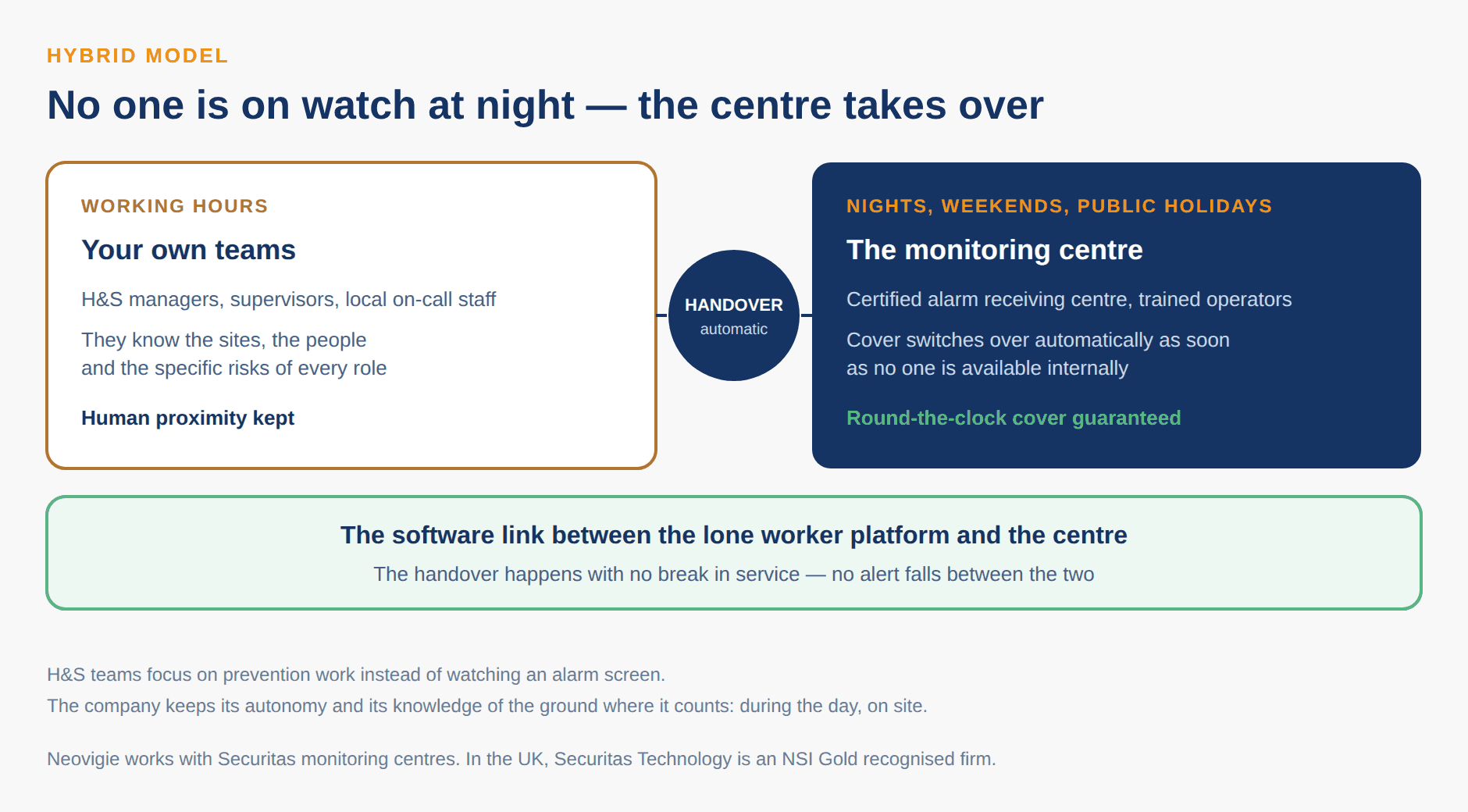
The result: local knowledge where it counts, permanent cover where you cannot provide it, and health and safety staff who are not carrying a phone at 3am for a shift they are not paid for.
Lone worker monitoring means processing personal data about employees, which puts it squarely inside UK GDPR. The defensible position is data minimisation: the centre receives exactly what an operator needs to get help to a person, and nothing else.
In a well-configured system, that means:
Two points that matter more than they look:
Location should be shared on alarm, not continuously. A system that streams employee position all day is a tracking system with a safety feature attached. A system that stores position but only reveals it when an alarm fires is a safety system. Workers can tell the difference, and so can their union.
Tell people, in writing, before you deploy. Purpose, what is collected, when location becomes visible, who can see it, and how long it is kept. Projects that skip this step do not fail technically. They fail because nobody wears the device.
Anyone quoting a single per-user figure without asking questions is guessing. The variables that actually move the price:
One cost that never appears on a quotation: the false alarm. A system that cries wolf gets abandoned, and an abandoned system costs whatever you paid for it and delivers nothing. Treat the false alarm rate as a commercial criterion, not a technical footnote.
Take these to a supplier meeting. The quality of the answers — and the speed of them — tells you most of what you need to know.
A supplier who cannot answer questions two, three and nine precisely is selling you something other than a monitored service.
Neovigie provides the lone worker platform and the devices — a dedicated hardware unit, a smartphone application, a Wear OS smartwatch, and a satellite beacon for areas with no cellular coverage — and works with Securitas monitoring centres for alarm handling, in France and in the United Kingdom.
Three design decisions are worth stating plainly, because they are the ones buyers ask about:
If you are scoping a UK deployment and need the monitoring arrangement, certification scope and police response route set out in writing for a tender, ask us directly and we will confirm the position for your specific requirement — better to have it up front than to discover a gap at evaluation.
Alarm receiving centre. It is the permanently staffed facility that receives, verifies and escalates alarm signals from remote devices — lone worker devices, intruder alarms, fire systems and CCTV, depending on its scope of certification.
No, and the difference is the whole point. A call centre answers calls. An alarm receiving centre is certified against standards covering the building, its power and communications resilience, its staffing levels and its documented procedures — and it can hold a URN allowing it to pass alarms to the police as monitored alarms. An out-of-hours answering service cannot do that.
There is no law that names an ARC as mandatory. What the law does require, under the Health and Safety at Work etc. Act 1974 and the associated regulations, is that you assess the risk to lone workers and put proportionate arrangements in place. Where your risk assessment identifies workers who could be incapacitated with no one to notice, an arrangement that depends on somebody voluntarily answering a phone at 3am is difficult to defend as proportionate. This is guidance, not legal advice — take your own on the specific duty.
BS 8484:2022 is the British Standard code of practice for the provision of lone worker services. It covers the device, the provider and the alarm receiving centre together. You are not legally obliged to specify it, but it is the clearest single way to make competing offers comparable, and certification is typically what makes a police response route available.
Where the alarm reaches them through a certified alarm receiving centre holding a valid URN, it is handled as a monitored alarm. Without that route, it is treated as an ordinary emergency call. Response is always at police discretion and depends on the information the operator can provide — which is exactly why the verification step matters so much.
It is quoted per user per month and varies with device type, whether ARC monitoring is included, volume, contract length and how much indoor location hardware is involved. Any figure offered before those questions have been asked is not a price, it is a guess. Ask for a quotation scoped to your actual sites and shift patterns.
During working hours, often yes — and your own people bring site knowledge no external centre has. The difficulty is permanent cover: nights, weekends, bank holidays, absence and turnover. The hybrid model exists precisely for this, keeping daytime alarms internal and transferring out-of-hours cover to the centre automatically.
The operator works the contact chain, which must include at least one nominated contact besides the worker. If no one can confirm the worker is safe, the operator escalates to the emergency services. Every step is timestamped and retained, which is what allows you to demonstrate afterwards what was done and when.


